Showing posts with label Trollope. Show all posts

Tuesday, April 2, 2013

Review: The Pallisers (1974) -- Episodes 20 - 26

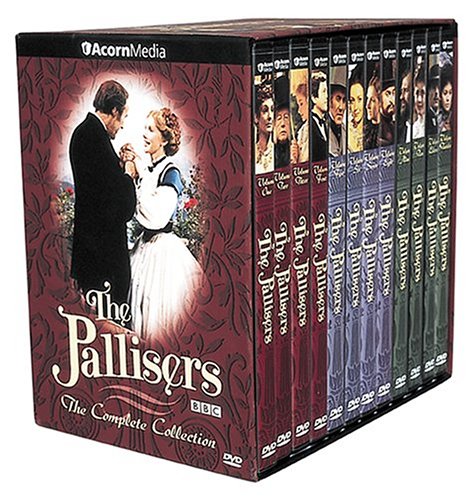
And so I present to you my final review of The Pallisers. (Though, in truth, I finished watching it about a month ago). It was a great ride watching it with my mom, and as the 26 episodes drew to a close, I felt a little sorry that it had to end, but at the same time it ended at a good place. Some series tend to be dragged on further than when it should have ended, so I think Anthony Trollope (and by extension the screenplay writers) made a wise decision to end it when they did.

Note: This review contains spoilers from the previous sections. If you do not want to encounter spoilers, do not read this review. I do encourage you to read the first review, the second review, and the third review of The Pallisers, though.

Synopsis

The Pallisers finishes up with the concluding episodes chronicling the events that occur in Anthony Trollope's books, The Prime Minister and The Duke's Children. Plantagenet Palliser, the Duke of Omnium, is raised to the position of prime minister, something which his wife, Lady Glencora, take advantage of socially. Plantagenet and Glencora's children, Lord Silverbridge, Gerald, and Lady Mary Palliser, have grown up and become main characters in The Pallisers and the story focuses on their lives.

Tuesday, March 12, 2013

Review: The Pallisers (1974) -- Episodes 15 - 19

And a Happy Birthday to me! :-D. So on my birthday, I will continue with my Pallisers reviews. And after this, one more Pallisers review and this review series will be complete. But anyways, I've had been enjoying The Pallisers at this point in the series and continued to watch and review it (I have finished it already, but I'm a little behind on the reviews). But enough of that: here's the review for the next part!

Note: This review contains spoilers from the previous sections. If you do not want to encounter spoilers, do not read this review. I do encourage you to read the first review and the second review of The Pallisers, though.

Box Set
Synopsis
These episodes of The Pallisers follow the events that happen in the book Pineas Redux in Anthony Trollope's Pallisers series. The story continues to focus on Phineas Finn's and Lizzie Eustace's stories, but slowly brings back Plantagenet and Glencora Palliser's story and chronicles Plantagenet's ascension to dukedom. After loosing his wife and child, the mourning Phineas Finn returns to England to continue his political career. While continuing his friendship with Lady Laura while she is separated from her husband, Phineas Finn makes an enemy out of Laura's husband, Robert Kennedy, who has lost his reason. Meanwhile, Lizzie Eustace has married Reverend Emilius, who treats her poorly and who may still be married to a woman in Prague. Lizzie manages to escape and finds refuge with the Bonteens, Mr. Bonteen being Phineas Finn's political rival.

Monday, February 25, 2013

Review: The Pallisers (1974) -- Episodes 7 - 14

Here is the next part of my review of The Pallisers. I was quite impressed with the first six episodes and eagerly continued to watch it. I expected the focus to still be on the Palliser family, though maybe not as a main focus, but to my disappointment the Pallisers were there only a little bit. However, there is still focus on a fairly interesting story line in that of Phineas Finn, an Irish politician, which becomes the main focus of these episodes.

Note: Unlike most multi-part period dramas, this review doesn't contain spoilers from the previous section. But I encourage you to read the first review.
Box Set

Synopsis
The Pallisers continues with episodes 7 through 14 recounting the events in the next two books in the Pallisers series, Phineas Finn and The Eustace Diamonds. Phineas Finn is an up and coming politician from Ireland that gains popularity quickly, though at times he can be a little naive about his fellow politicians. Later in the episodes, Lizzie Eustace, a recent widow, was given her husband's diamonds as he laid dying, but there is a question as to whether the diamonds actually belong to the estate and whether Lizzie has the right to keep them. Lizzie is determined to keep her diamonds by scheming those around her... until it all goes wrong.

Monday, February 4, 2013

Review: The Pallisers (1974) -- Episodes 1 - 6

My mom and I have started on another series a while ago! This will also be the first period drama that I will be watching for Miss Laurie's Period Drama Challenge (which if you're not participating in, you should be). I'm splitting up the series into multiple reviews since there is so much that is going on, but all the reviews will count as one period drama for the Period Drama Challenge.

But anyways, my mom and I started watching this series a little while ago. We had already seen three period dramas based off of the books of Anthony Trollope and we enjoyed them (some more than others). My mom happened upon this at Amazon and had asked if I had heard of The Palliswers (which I had heard of a while ago) and she bought it for us to watch. We didn't know too much about this series (I knew it had Susan Hampshire in it, who was also in The Barchester Chronicles, and that it was about politics), so we sat down to watch it without knowing very much of it.

Box Set
Synopsis
Adapted from The Pallisers series written by Anthony Trollope, the first six episodes follow the events in the first book in the series Can You Forgive Her?. Pressured by her aunt to marry the rich and future duke of Omnium, Plantagenet Palliser, Lady Glencora M'Clusky marries the older Mr. Palliser though she is still in love with the roguish Burgo Fitzgerald. Meanwhile, Glencora's cousin, Alice Vavasor, is engaged to John Grey, but she begins to fall back in love with her cousin, George, who she was engaged to but rejected due to his being unfaithful.

Monday, June 20, 2011

Sneak Peek of Film Tournament #3!

The last of the sneak peeks! The Period Drama Film Tournament will be upon us soon! So, the last contestant that I will reveal will be...


He Knew He Was Right (2004)!

He Knew He Was Right focuses on the marriage of Louis and Emily Trevelyan. For their first year of marriage, the couple has a son and a happy life. When Colonel Osbourne, Emily's godfather, pays her visits very often, Louis suspects that Emily is cheating on him with Colonel Osbourne. Other subplots include the romance between Nora Rowley, Emily's sister, and Hugh Stanbury, Louis's best friend, the comical vicar Mr. Gibson and two dueling sisters who fight over him, Hugh's sister, Dorothy, staying with her Aunt Stanbury, among others.

Reviews!

Part 1 of He Knew He Was Right


Head over to Old-Fashioned Charm to see what Miss Laurie's Sneak Peek is! This is the last sneak peek! The tournament will be starting on June 22, which is two days from now! Are you excited?

Sunday, November 14, 2010

Review: He Knew He Was Right

Lastly in The Anthony Trollope Collection, my mother and I watched He Knew He Was Right. There are a couple of funny subplots, but one serious main plot. Here are some of my thoughts.

Synopsis
Box Art
After a year of being happily married, Louis and Emily Trevelyan (Oliver Dimesdale and Laura Fraser) have a son and a nice home in London. Troubles befall their marriage when Louis suspects Emily of cheating on him with Colonel Osborne (Bill Nighy), her godfather. Though Emily is not cheating on Louis, she still refuses to submit to Louis's wishes that she not see him.

The story has many subplots. One involves Emily's sister, Nora Rowley (Christina Cole), and Louis's friend, Hugh Stanbury, and how they fall in love. Another involves Hugh's sister, Dorothy, visiting her Aunt Stanbury, an old maid with money; Aunt Stanbury would like to see her married to the vicar, Mr. Gibson (David Tennant), however Dorothy likes someone else. Another involves sisters, Camilla and Arabella French (Claudie Blakley and Fenella Woolgar), fighting over Mr. Gibson. As you can see, there are many subplots, however they can be viewed on their own, as some don't involve the main plot.

Characters
The acting was alright. It was interesting how the characters would face the camera and tell the "audience" what they were thinking. I don't always like it when movies do that, but it didn't really bother me here.

Mr. Gibson (David Tennant) with Camilla (Claudie Blakley)
to the right and Arabella French (Fenella Woolgar) to the
left.
 I honestly preferred the subplot characters to the main characters. The subplot with Mr. Gibson was probably the best part of the story; all the characters were so hilarious! Camilla French became physchotic and irrational about Mr. Gibson, while Mr. Gibson was absolutely afraid of her (at one point, he was actually cowering under a plant!)! This subplot was probably the best subplot in He Knew He Was Right. It was just so hilarious!

In He Knew He Was Right, there are two American sisters, the misses Spaldings. I didn't mind their characters, but I did have a slight problem with them: whatever accent they were speaking was not an American accent. As an American, I never have heard anyone speak they way they did. Though the one Miss Spalding, Caroline (Anna-Louise Plowman), was born in New Zealand, so maybe that had something to do with it. But either way, the accents that the American characters were speaking did not sound American.

Wow, was it odd to see Christina Cole in a completely different role! Her previous role were (to name a few) Mrs. Elton from Emma and Clarissa Payne from What a Girl Wants: both roles were catty women who want to control everything. Here as Nora she was pleasant and sweet, and she was able to pull it off well! I thought that the only roles that she could get were of catty women, but here she proves that she is much more versatile, as Nora was such a sweet character.
The main characters... I felt sorry for Emily because she really didn't do anything wrong. Colonel Osborne seemed to like causing trouble: he knew that something was going wrong everytime him an Emily met, and he should have either stopped coming to see Emily or simply talk to Louis. Louis himself became more and more crazy as the story went on. Again, I really perferred the subplot to the main plot (which is probably not a good thing) probably because the subplots were more entertaining. Spoiler The main plot just seemed to be a downward spiral in which it wasn't getting better for the characters. I tend to like happy endings to sad endings. End of Spoiler
Scenery
The country scenery was very nice, but some of the scenes in London had dark overtones to illustrate the seriousness of the story.  Some of the scenes take place at balls where the buildings look very nice and towards the beginning, the Trevelyans had a very nice house, but the other indoor scenes took place in either simpler cottages or completely run down homes. Some of the scenes also seemed to take place on either cloudy or "about to rain" days, so there were some dark overtones. This was appropriate due to the seriousness of the main plot.

Costumes
Nora (Christina Cole) with Emily (Laura Fraser) as
they leave London. 
Some of the costumes were quite nice. Emily was always well dressed and always looked nice. She had very nice dresses (white seemed to work very well for her) and her hair was also very nicely arranged. Nora was also nicely dressed; I think her clothes tended to have more bolder colors than Emily's.

The French sisters had similar clothes on the whole movie. They wore lightly colored dresses with a print. This was probably to illustrate how similar they were (at least at the beginning). Their clothes didn't really differ in style; as a poorer family, their mother probably couldn't afford a big wardrobe.

Something that my mother and I noticed: Dorothy seemed to wear the same dress throughout the whole miniseries. She seemed to be wearing the same plaid, high necked dress throughout her whole stay with Aunt Stanbury. I suppose that since her family was poor, she didn't have a wide variety of dresses, but it was still something that we noticed.

Aunt Stanbury also wore the same dress throughout the entire movie: the same black dress with the same black and white lace veil. I suppose that because she is older and unmarried, she has a little excuse.

Music
The music didn't really stand out for me as much. Most of the songs are very serious due to the serious nature of the main story. The songs did not really strike me as they do for other period dramas. There is no soundtrack available that I know of.

Overall: 3.5/5
I enjoyed He Knew He Was Right, but I would probably reccomend the subplots to the main plot. The subplots themselves could have been their own movie: they were that separate from the main plot. To me, a miniseries shouldn't have that happen. I didn't hate the main plot, but I much more enjoyed the subplots because the main plot was really serious. However, a lot of the costumes were very pretty and the country scenes were very nice. The acting was well done, and I would not be sorry to watch it again.

He Knew He Was Right is a part of The Anthony Trollope Collection, though you can also buy it separately. It runs for 235 minutes with four one hour long episodes. It is available on DVD.

Monday, November 8, 2010

Review: The Barchester Chronicles

Next in the Anthony Trollope Collection, my mother and I watched The Barchester Chronicles. At first I didn't think that it was going to amount to much, but was I wrong! I really enjoyed it. Here are some of my thoughts.

Synopsis
The Barchester Chronicles is taken from two books in The Chronicles of Barsetshire by Anthony Trollope. Episodes 1 and 2 are taken from The Warden. John Bold, a doctor, takes legal action against Mr. Septimus Harding (Donald Pleasence), a clergyman and warden of Hirams Hospital. While John Bold is good friends with Mr. Harding and in love with his daughter, Eleanor, he still believes that Mr. Harding is making too much money and is in violation of a will.

Episodes 3 through 7 are taken from Barchester Towers. When the bishop of Barchester dies, a new bishop is appointed. Bishop Proudie (Clive Swift) is a weak man controlled by his wife and chaplain, Mr. Slope (Alan Rickman). The plot's of episodes 3 through 7 revolve around the clergymen of Barchester and their relation to Bishop Proudie and Mr. Slope.

Characters
There are some very recognizable actors and actresses in The Barchester Chronicles: Donald Pleasance as Mr. Harding, Alan Rickman (Sense and Sensibility) as Mr. Slope, Clive Swift (Keeping Up Appearances) as Bishop Proudie.

Mr. Harding was such a lovable character! He was such a sweet old man that I couldn't believe that John Bold was making trouble about him. It wasn't like he was a greedy, mean man: he was a nice, old man who liked music and he would spend his time training the choir for church. He was one of my favorite characters throught this whole miniseries.

Mr. Slope seemed to just ooze his way onto the screen, and it worked for him. You really got the impression that this man is a scheming, controlling man who is out to better his position. He would call on the women of Barchester, even Eleanor and Mary Bold, her friend, however they did not like him calling on them and would laugh at how he was so full of himself. He was almost comical on how "odious" he was.

Poor Bishop Proudie... I recognized Clive Swift from Keeping Up Appearances, and it seems that he's stuck in a similar role. In Keeping Up Appearances, he played the quiet, pushover (it's sounds so cruel, but it's true) husband of Hyacinth Bucket. Here he had practically the same role, except here he was more of a puppet.

Scenery
Mr. Slope (Alan Rickman) talking to Mrs. Bold (Janet Maw).
The scenery was not the best compared to more recent BBC productions. Though The Barchester Chronicles is a BBC production, it was made in the early 80's; the cameras were not as good then as they are today and most of the scenes were usually filmed on a set.. Some of the scenes did, as I have read in other reviews, look more like a play than a miniseries. The outside scenes did not appear to take place on a set, though.

Costumes
The costumes were nice, but there was a concern that I had. In episodes 3 through 7, it looked like Eleanor was wearing the same *Spoiler* mourning dress. *End of Spoiler* For episodes 1 and 2, she had some varying dresses, which were nice, but in episodes 3 through 7, her clothes barely changed at all. She might have had another mourning dress on once or twice, but for the most part, she had the same dress on for most of the miniseries. It could have been that there wasn't that big of a costume budget.

Signora Neroni (Susan Hampshire) did have some nice dresses. They were very elaborate and pretty, although there was one that was a little low cut. I also loved some of the hair decorations that she had. Though I did not really like her character, she did look pretty.

Music
There really isn't too much music to speak of for The Barchester Chronicles. The music that is there is made up of very nice choir music. There was not much music during the episodes excepting the choir scenes and maybe the party scenes, maybe. In short, if you were expecting a full soundtrack, you won't find one here.

Overall: 4/5
Signora Neroni (Susan Hampshire) sitting with guests,some
of which are Mr. Slope and Dr. Arabin (Derek New).
This was very interesting to watch. The first two episodes were a little boring, though: they spent too much time on the legal affairs, so there was a lot of dialogue about law. Once you get past the first two episodes, the rest was humorous and entertaining! There weren't any questionable scenes throughout the whole miniseries, and wouldn't be inappropriate to show in a class. It does come across as more of a play than a movie possibly due to the cameras (this was made in the 80s). Other than that, it is a good quality film that could be watched together as a family.

The Barchester Chronicles is available on DVD and is one of three miniseries in The Anthony Trollope Collection, though you can buy it separately from the collection. It is 385 minutes long, made up of seven 55 minute episodes on two disks.

Tuesday, October 5, 2010

Review: The Way We Live Now

My mom bought the Anthony Trollope Collection at Amazon one day that included three miniseries: The Way We Live Now, The Barchester Chronicles, and He Knew He Was Right. We watched The Way We Live Now over a couple of weeks first. It was one... interesting miniseries. Now, how do I define "interesting"? Well, read on and decide for yourself.

Synopsis
Talk arises over London when the mysterious, rich, and very strange Mr. Melmotte (David Suchet) arrives with his wife and daughter. Meanwhile, the Carburies have fallen on hard times: Sir Felix Carbury (Matthew MacFayden), the son of Lady Carbury, a gambler and a ladies man, has spent all of his mother's saved money leaving his mother and sister, Hetta, to dodge creditors. Hetta does not like dodging from creditors, but she obeys her mother. When Sir Felix meets the rich Marie Melmotte (Shirley Henderson), Marie falls in love with Sir Felix, while Sir Felix is only marrying Marie for her money. Lady Carbury wants Hetta to marry her cousin Roger Carbury, who has the Carbury estate and money, but Hetta has fallen in love with Paul Montague, Roger's friend who has a mysterious past. Many Subplots follow in The Way We Live Now.

Characters
If I could pick one word to describe most of the characters excepting Hetta and maybe a few others (and that's a big maybe), it would be "weird". I never read the book, but seriously, could they have found weirder actors to play these very bizarre characters? I honestly don't think so. First off, you have Marie Melmotte, who you would think "maybe she's a little shy and awkward, but she might turn out to be a little normal", but then you hear her voice. Out of this woman comes the voice of a very nasal, high pitched child -- the sound did not fit the picture. Melmotte himself was a very wierd character; between his bad table manners, his temper, and how he wormed his way around business, he was just a very odd character. Another character, Paul Montague, I at first thought that he was a somewhat normal character, but then they dug into his past, and let's just say, he's not as innocent as I initially thought. Lady Carbury, again, another weird character. She was a flirt (determined by her behavior and her attire) and was encouraging Sir Felix to marry Marie Melmotte for her money. The list goes on, leaving only a few characters somewhat "normal" and only one that really is "normal".

Hetta Carbury (Paloma Baeza) looking at Sir Felix
and Lady Carbury with disgust.
While most of the characters were very weird, it was still comical; when my mother and I were watching, we had to laugh at the very odd body language that was before us. But at the same time, it was just plain weird

The only one that was truly innocent was Hetta. I would have to say that she must have been the only "normal" character throughout the whole miniseries: she had what I would say "a good head on her shoulders"; as cliched as that sounds, it is true. She didn't have a mysterious past with deep, dark secrets and she had strong morals (and actually stuck to them). She was a breath of normalcy in the midst of all the odd characters that appeared on the screen. It is my opinion that in order to like something, whether it is a book, movie, or television show, there must be at least one character that you like. Here, Hetta fills the requirement: she gives the audience someone to relate to.

Scenery
As normal for BBC productions, the country side is pretty. In The Way We Live Now, dark colors are utilized in order to highlight the dark overtones of the story. The hallway in the Melmottes' home, though mostly white, still appears to have a dark atmosphere. Melmotte's study in itself was dark, fitting to Melmotte's scheming, dark character. I personally do not care for dark overtones to movies, but I would say that it did fit for this film.

Costuming
I did like the costuming. The costumes featured bustles, which were popular at the time (in fact, the miniseries is supposed to take place in the 1870's, the first era of bustles). The ladies dresses did fit their personalities: Hetta had dresses that were modest and pretty which fits with her sense of morality; Lady Carbury had more revealing dresses which fits with her flirtation; Mrs. Hurtle, a woman from Paul Montague's past determined to marry Paul and will take revenge if he double crosses her, is dress in dark colors, appropriate for her. So, the costumes were well done.

Overall: 3/5
I did enjoy watching this: the plot was very complex and kept you wanting more, and even though most of the characters were very odd, they did provide some comical moments. However, there are some faults which might not be very easily overlooked. Firstly, I would not recommend showing this to children: there are some adult situations, that, though short, were still enough to make most people (even adults) blush. Another one of the faults was that the three episodes that lead up to the forth/final episode were building up to something big, but then the forth episode came and it was a bit of a let-down and it left you hanging. It almost felt like there should be more of the story, but the writers were either short on time or didn't have enough time to fit everything into the allotted time. Lastly, though the plot was interesting, it was still very complex with a couple of different subplots going on simultaneously with the main plot. This is not something that you can watch while doing something else and understand what's going on. You actually have to sit down without many distractions and watch what is going on in order to understand what is going on.

The Way We Live Now is made up of four one hour and thirty minute episodes. It is available on DVD either on it's own or in The Anthony Trollope Collection with two other miniseries.