Showing posts with label Reader Question. Show all posts

Thursday, September 5, 2013

Reader Question #17: Jane Austen Spin-offs?


This week's Reader Question comes from Miss Jane Bennet from Classic Ramblings. Jane asks:


I was wondering what your thoughts are on sequels/adaptations of Jane Austen's work. Do you like/dislike them? Are there any particularly good ones?
Jane also commented that this could also include spin-offs of Jane Austen's works.

Thursday, August 22, 2013

Reader Question #16: Getting Along with Jane Austen's Heroines


After a couple of weeks, I finally have another Reader Question answered. Here is another question asked by Charity from Austenitis:


List your favorite JA heroines in order of how well you'd get along with them, and tell us why. (or could list by how much you admire them, how similar you are to them, etc)

Thursday, August 8, 2013

Thursday, August 1, 2013

Reader Question #14: Willoughby vs Wickham

It's that time of week again! This is another Reader Question from Charity from Austenitis. Charity asked:
What are the similarities and differences between Willoughby and Wickham?

Thursday, July 25, 2013

Reader Question #13: Introducing Someone to Jane Austen

Continuing with the questions that Charity from Austenitis sent me, it's time for another Reader Question! Charity asked:
If you had a friend who had never watched a period drama, but was ready to start with a Jane Austen film...which one would you recommend?

Thursday, July 18, 2013

Reader Question #12: Period Drama TV

I'm going to try to get back into Reader Questions. It's been quite a long time since I did these. My good friend Charity from Austenitis sent me an E-mail with a lot of questions in it a long time ago, but due to my busy school year, I didn't have much of a chance to write any of them up. So, getting back into Reader Questions, I will answer Charity's questions. At this point on (provided that there are reader questions for me to answer), I will try to get a Reader Question post out every Thursday.

Charity asked:
Which period drama TV shows are your favorites? Which ones do you recommend highest? 

Tuesday, January 8, 2013

Reader Question #11: My Favorite Non-Period Drama Films

Finally, I'm restarting Reader Questions! I've felt bad about slacking off on Reader Questions, but I'm glad that I can finally restart them again! Make sure that if you think of a question that you comment it in somewhere; I try to answer all of them, but if I can't come up with a good-sized post about it, I'll comment back with my short answer.

This question (and a bunch of others!) comes from Charity from Austenitis. Charity asks:
I have to ask...what non-period-drama films are your favorites?

Thursday, October 4, 2012

Reader Question #10: Jane Austen vs. Charles Dickens

And after a little hiatus, I'm back to doing Reader Questions! This question came to me from Violet from Violets and Daisies. Violet asked:

I was just wondering why it is that so many people seem to read/watch lots about Jane Austen (particularly in all the blogs I've discovered), but very few seem to prefer Charles Dickens and period dramas based on his books? I guess it is all down to personal preference, but I just always wonder why it is that way when I personally prefer his writing over hers. Any thoughts on this?

Wednesday, September 5, 2012

Calling For More Reader Questions!


This happened a little while ago, but I've run out of Reader Questions to answer. If you have a question that you would like answered in a post, feel free to leave a comment.

The Reader Questions could be about anything related to Elegance of Fashion, whether about Period Dramas, Sewing/Needlecraft, or Blogging in general.


 God Bless,
God Bless, Miss Elizabeth Bennet

Tuesday, August 14, 2012

Reader Question #9: Pride and Prejudice (2005) Costumes

This question came to me from Miss Elizabeth from The Country Handmaiden. Miss Elizabeth asks:

I had a question about regency fashion. I don't think so, but were sleeveless gowns historically accurate to the times? I saw an example on Miss Bingley in P&P 2005 at the dance and took a second look when I saw that dress. I know that movie definitely had some historically incorrect points about it so I wondered. It doesn't seem like it would be period correct. Also, did you notice that almost all of the ladies were dressed in white for the Bingleys' dance? Was white a particularly fashionable color?

As you all read this post, keep in mind that I've only seen half of Pride and Prejudice (2005) and clips from later parts of the movie. But I believe that this is the dress in question:

Thursday, August 9, 2012

Reader Question #8: Examining Pride and Prejudice (1995)

This reader question came to me from blowback. blowback writes:

With respect (of the deepest kind) to Pride and Prejudice, what do you miss from the book that never made it onto the small screen (1995 BBC/A&E version of course) and which, if any, of the additional/re-created scenes did you enjoy/think worthwhile. Anything to do with a certain pond (with a significant smile, nodding head towards Lyme Park) is disallowed!

Tuesday, August 7, 2012

Reader Question #7: Jane Austen and Charles Dickens's Faults

This question comes from Kiri Liz from Lianne Taimenlore. Kiri Liz asked:


What do you think Jane Austen's worst fault was as a writer? Charles Dickens's worst fault? And what, in your opinion, could they have done to remedy that fault?

Wednesday, August 1, 2012

Reader Question #6: Favorite Character and What I Would Change

This question came to by from an anonymous reader. This anonymous reader asked:


Who is your favourite period drama character? Why?
If you could change something in a period drama movie, what would it be?

Friday, July 27, 2012

Reader Question #5: Austen, Dickens, Gaskell, and Bronte, Oh My!

This question come from Birdienl, who writes:


What do you think are the unique points of the stories (books or adaptations) of each of these great writers: Jane Austen, Charles Dickens, Elizabeth Gaskell, Charlotte Brönte (add others if you like), which distinguish them from other writers.

Wednesday, July 25, 2012

Reader Question #4: Mr. Darcy's Proposal What If

This question came to me from Scullery Maid. Scullery Maid writes:


Do you think Lizzy would have accepted Darcy the first time if she had never met Wickham, and if Colonel Fitzwilliam hadn't told her about Darcy's separating Bingley and Jane?

Tuesday, July 3, 2012

Reader Question #3: Chivery vs. Clennam and Jarndyce vs. Woodcourt

This question came to me from Payton from Dirt and Dickens. Payton writes:

In Little Dorrit, Amy receives a proposal from a wonderful guy, John Chivery, but she rejects him and ends up marrying Arthur Clennam. Likewise, in Bleak House, Esther initially accepts Mr. Jarndyce's proposal, but ends up marrying Allan Woodcourt. Both Mr. Jarndyce and John Chivery are amazing guys and true gentlemen, and it's hard to watch them get rejected. So should Amy have married John? Should Esther have married Mr. Jarndyce? Whose team are you on?


Having not read Bleak House or finished reading Little Dorrit, I have to go off of the miniseries for each.


So to answer this question, I'll start off with Little Dorrit. I don't have much against John Chivery, but I honestly prefer Arthur Clennam. I was happy that Amy married Arthur; sure, he was a bit older than her, but he was a good guy. He is responsible for his mistakes, wants to right wrongs, and is an overall good guy. I'm sure he would be a great husband for Amy.


I don't think I would be as happy if Amy married John Chivery. Why? It's not that John Chivery would have been a bad husband for Amy (though her life would certainly be different if she married him), but I guess there's not much of a reason for it other than I got used to the idea of Arthur and Amy getting married before John Chivery even proposed to her.

Now, for Bleak House. I liked both Mr. Jarndyce and Allan Woodcourt (oh my, I keep wanting to write Woodhouse! Way too much Jane Austen? Impossible! You can never have too much Jane Austen! :-P). They were both gentleman and truly cared for Esther. Neither of them had hidden, deep, dark secrets that would potentially ruin them. They always acted properly and had good hearts. So, which one did I prefer Esther end up with? Allan Woodcourt.

But why not Mr. Jarndyce if I liked him so much? Yes, Mr. Jarndyce is a good guy and I liked his character greatly, but he was far, far too old for Esther! Sure, for Little Dorrit Arthur and Amy had a fairly big age gap (about 19 years), but not as big of a age gap as Mr. Jarndyce and Esther (Okay, so I don't know how old Mr. Jarndyce was supposed to be, bit I had the impression that the age gap for him and Esther was pretty big). I could see him more easily as Esther's father (or grandfather even?) rather than her husband. Allan Woodcourt seemed closer to Esther's age than Mr. Jarndyce and seemed like he could be more like a husband to her than Mr. Jarndyce. If it weren't for Mr. Jarndyce's age, I would have been happy if Esther chose either one of them; it simply all came down to age.


So, I'm pretty much certain that Dickens was right in keeping Amy with Arthur Clennam and Esther with Allan Woodcourt. What do you think? Do you agree? Disagree? Leave a comment!


Thank you, Payton, for sending in your question! If you have a question you would like to submit for me to do a post on, leave a comment. Just follow these guidelines. It can be about anything related to this blog: period dramas, blogging, reviews, etc.

 God Bless,
God Bless, Miss Elizabeth Bennet

Thursday, June 28, 2012

Reader Question #2: Willoughby - Sympathetic or Scoundrel?

Question #2 comes from Miss Dashwood from Yet Another Period Drama Blog. Miss Dashwood asked:


Do you believe Willoughby in Sense and Sensibility is a sympathetic character or an out-and-out scoundrel?


Like Miss Dashwood said in her original comment, I have seen there are two sides to the argument. On the one hand, some people say that Willoughby is sympathetic since because of his abandonment of Eliza Williams and the fact that he was subsequently disinherited, he is now married to a woman he does not love, is away from the woman he loves, and finds out that he could have been married to the woman he loves and get his inheritance back. On the other, some say that his actions were so awful that he is a scoundrel, period.

So, for my opinion now. I believe that Willoughby is a out-and-out scoundrel and the author of his misery. I do not have any sympathy for him at all. Why? Well, besides the fact that his actions were awful: 

1. He made some very bad decisions and kept making them.
It seems to me that if Willoughby did not make his first initial mistakes, he would not have caused as much pain as he did (to himself and others) and wouldn't have been the scoundrel that he became. As we read/watch Sense and Sensibility, we find out eventually that Willoughby abandoned Eliza Williams (Colonel Brandon's ward) and left her to care for her child alone. After he made those mistakes, he continually kept making more and more bad decisions.  It became a very slippery slope for him. Let's look at the bad decisions and results after the initial bad decisions and how they lead into each other:
  • Bad Decision: After leaving Eliza, Willoughby meets Marianne Dashwood and encouraged her to love him without any intention of returning her feelings. Result: Willoughby ends up falling in love with Marianne anyways.
  • Bad Decision: When Mrs. Smith finds out about Willoughby's initial bad decisions, she tells Willoughby to do the honorable thing and marry Eliza Williams. Willoughby does not: he doesn't love Eliza and loves Marianne. Result: Willoughby is disinherited and has no way to pay of the debts he has.
  • Bad Decision: Willoughby now has two choices: watch the money he currently has, economize, and marry Marianne or find a rich woman to marry and abandon Marianne completely. Guess which one he picks. (It's the latter for those who don't know). Result: Marianne is heart broken and Willoughby marries Miss Grey with fifty-thousand pounds a year and is in an unhappy marriage.
  • Overall Effect: Because of the initial bad decision, he is now married to a woman that he does not love and is separated forever by the woman he loves.
What would have happened if Willoughby had done the right thing in the first place and not have done the harm he did to Eliza? Eliza wouldn't be disgraced and could find a respectable husband. Willoughby would be free to marry the woman he loved. None of the pain that he caused would have been inflicted in the first place.

Okay, so I suppose you can say, "Well, it's all nice and well to say that he shouldn't have done something. But it still happened and what was he to do?" Yes, it did happen, but he could have put a stop to all the pain by stopping himself from continuing to make all the bad decisions that he made. One bad decision lead to another when he could have stopped making bad/wrong decisions and ended the train of bad decisions. Similarly to how if someone lies and then they have to come up with more lies to cover up the first lie, and lies to cover up those lies... I could go on with that analogy, but it would take too long and we'd never see the end of it.

2. He shirks his responsibilities.
This kind of coincides with #1, but it's also on its own too. Willoughby doesn't take responsibilities for his bad decisions, which leads to even more bad decisions. He shirks his responsibilities when he abandoned Eliza Williams. He abandons Marianne very suddenly and doesn't make up for it. The way he shirks his responsibilities is not something a gentleman would do. Since he shirks his responsibilities, he winds up paying for it in the end by marrying Miss Grey and being in an unhappy marriage.

3. He's just an overall jerk!
Even ignoring how he continually makes bad decisions and shirks his responsibilities, Willoughby is simply a jerk and a bad influence on Marianne. If he doesn't particularly care for Colonel Brandon, fine, but don't talk about him behind his back and encourage the woman that Colonel Brandon loves to also talk behind his back too! He also encouraged Marianne to do things that would give the impression to everyone that they were engaged when he had no intention of marrying her at the time (remember the horse he tried to give her?).

So, that is my opinion on Willoughby: in short, I believe he is a scoundrel. What do you think? Is Willoughby sympathetic or is he a scoundrel? Leave a comment!


Thank you, Miss Dashwood, for sending in your question! If you have a question you would like to submit for me to do a post on, leave a comment. Just follow these guidelines. It can be about anything related to this blog: period dramas, blogging, reviews, etc.


 God Bless,
God Bless, Miss Elizabeth Bennet

Tuesday, June 26, 2012

Reader Question #1: Jane Austen and Proposals

And in what I hope will be a good long line of Reader Question Posts, here is the first question that I received. This question came to me from Melody from Regency Delight. Melody asked:

Why exactly do you think Jane Austen didn't write proposal scenes in Mansfield Park, Northanger Abbey, and Sense and Sensibility?

I can't really comment on Mansfield Park right now since I am very slowing (but surely!) reading through it (though I know a little about what happens at the end), but I can still comment on Northanger Abbey and Sense and Sensibility. This question brings to mind the following quote from Sense and Sensibility:

Proposal Scene from Sense and Sensibility (2008)
How soon he had walked himself into the proper resolution, however, how soon an opportunity of exercising it occurred, in what manner he expressed himself, and how he was received, need not be particularly told. This only need be said;—that when they all sat down to table at four o'clock, about three hours after his arrival, he had secured his lady, engaged her mother's consent, and was not only in the rapturous profession of the lover, but, in the reality of reason and truth, one of the happiest of men. (Chapter 49)

Proposal Scene from Northanger Abbey (2007): not
necessarily the way I pictured the proposal
in Northanger Abbey.
So, to answer the question directly, I think that Jane Austen didn't write a proposal scene for either Northanger Abbey and Sense and Sensibility because it simply wasn't necessary (it needed not to be particularly told). In Northanger Abbey and Sense and Sensibility, we as the reader know that Henry Tilney loves Catherine Morland (though she was kicked out of Northanger Abbey by General Tilney) and we know that Edward Ferrars, despite his engagement and supposed marriage to Lucy Steele, loves Elinor Dashwood. So, I think that by the end, we the reader can assume that if Henry Tilney or Edward Ferrars arrived to speak to Catherine or Elinor, that there could only be one reason why: to propose. There isn't a doubt in the mind of the reader that the hero holds a very, very high regard for the heroine, so there is no need to get into a lengthy proposal scene.

Compare that idea with Emma or Pride and Prejudice or even Persuasion.

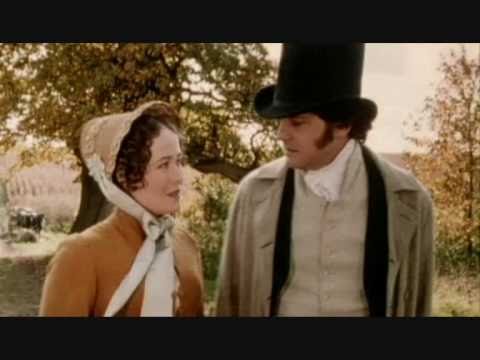
Pride and Prejudice (1995)
In Pride and Prejudice, we know that Mr. Darcy declared his love for Elizabeth and made a proposal to her that was rejected because Elizabeth greatly disliked him. But then the story goes on and we see that Elizabeth has come to love Mr. Darcy. When Lydia creates scandal by eloping with Wickham, Elizabeth is sure that Mr. Darcy wouldn't renew his love to her and would not propose again. After all, he knows all about Lydia's scandal and went through all that trouble to fix it. Why would he involve himself with the Bennets that had a scandal that people actually heard about? Sure, his sister almost had a scandal herself, but it was hushed up and no one heard of it. So, when Elizabeth went walking with Mr. Darcy, she didn't think that he would renew his proposal to her. But lo and behold! he still loves Elizabeth and proposes marriage to which Elizabeth accepts!

Emma (2009)
In Emma, the last time that Emma saw Mr. Knightley before he proposed, Mr. Knightley was very angry with her for humiliating Miss Bates. Harriet said that she loved Mr. Knightley and that they talked quite a bit. Emma then realizes that she loves Mr. Knightley, but as Emma assumed (and the reader could/might assume too), Mr. Knightley wouldn't think of marrying her and that he would just marry Harriet Smith. In fact, even as the proposal scene starts, we might believe along with Emma that Mr. Knightley is going to tell her about marrying Harriet Smith. But, when the scene takes a turn and it turns out that Mr. Knightley loves Emma, we readers are assured that Mr. Knightley does not love Harriet, but loves Emma.

Persuasion Letter Scenes; image used in Persuasion Comparison guest post that I contributed to
Persuasion is a little more complicated. Captain Wentworth gives off a bunch of mixed signals to Anne to the point that neither she nor the reader knows what he plans to do. One minute, he's concerned about her walking too far and helps her into the Crofts carriage. Another minute, he completely ignores her for Louisa Musgrove. One minute, they're talking about how "a man does not recover from such a devotion of the heart to such a woman," at the concert, and then he leaves the concert early angrily. So in this case, we get some glimpse of Captain Wentworth's love for Anne, but at the same time, we see signs that he would not propose to her. So, in order to do away with any doubt, Captain Wentworth leaves the love letter for Anne that removes any doubt in her mind and in the mind of the reader.

In each case in Pride and Prejudice, Emma, and Persuasion, there is doubt in the mind of the heroine that the hero will not propose to her. And in each of the proposal scenes, the scene does not start out as a proposal scene, but rather a regular scene. In Emma, Mr. Knightley means to console Emma about Frank Churchill. In Pride and Prejudice, Elizabeth thanks Mr. Darcy for fixing Lydia's scandal. And in Persuasion, Anne and Captain Wentworth were visiting the Musgroves. The proposal dialogue is in there not only to remove the doubt of the readers and the heroines, but to ease the scene into a proposal scene. It wouldn't make sense if Jane Austen said, "On a walk, Elizabeth thanked Mr. Darcy and Mr. Darcy renewed his declaration from a couple of months ago and they got engaged!" The reader would be left confused: "What? How did this happen? Weren't they just walking around? Wasn't Elizabeth just thanking him? How did a proposal come up?" So, by adding proposal dialogue into a scene, a scene can ease into a proposal scene instead of shocking the readers into a proposal that they didn't think was coming.

Now, on another idea, a special case for why Jane Austen didn't write a proposal scene for Sense and Sensibility could stem from the fact that Sense and Sensibility is a satire of the sentimental novel. You know the kind I'm talking about. Where a proposal could last pages and pages and be filled with flowery, overly mushy language to make anyone uncomfortable. So Jane Austen not having a proposal scene with dialogue could be her way of poking fun at the overly dramatic, romantic proposal scenes in other novels. Instead of a flowery proposal, Jane Austen gives a description of the outcome and keeps it short, sweet, and to the point: the actual details of the proposal aren't discussed.

So, that is my opinion on why Jane Austen left out proposal scenes out of some of her novels. What do you think? Do you agree with me? Do you think there was another reason why Jane Austen left out proposal scenes in some of her books? Leave a comment! I'm very interested in what you all think!

Thank you, Melody, for sending in this question! If you have a question you would like to submit for me to do a post on, leave a comment. Just follow these guidelines. It can be about anything related to this blog: period dramas, blogging, reviews, etc.

 God Bless,
God Bless, Miss Elizabeth Bennet