Showing posts with label Great Expectations. Show all posts

Monday, April 23, 2012

Review: Great Expectations (2011)

My dear readers, I know I've been a little irregular in posting reviews, and I am most sorry for it. Things at school have gotten very busy lately, so I haven't had as much time to watch/review period dramas. But don't worry! School will be done for me at the start of May, so I will be back to posting reviews regularly. In the meanwhile, here is a review of the new Great Expectations to tide you over until my next review.

Well, Downton Abbey is over for another year... Now what to watch on Masterpiece Classic? Oh! Great Expectations will be playing soon! And so over a couple of weeks, I sat and watched Great Expectations. I had seen the 90s version starring Ioan Gruffudd and Justine Waddell, but didn't particularly care for it. But I thought I could watch this new version and see how it compares to the 90s version.
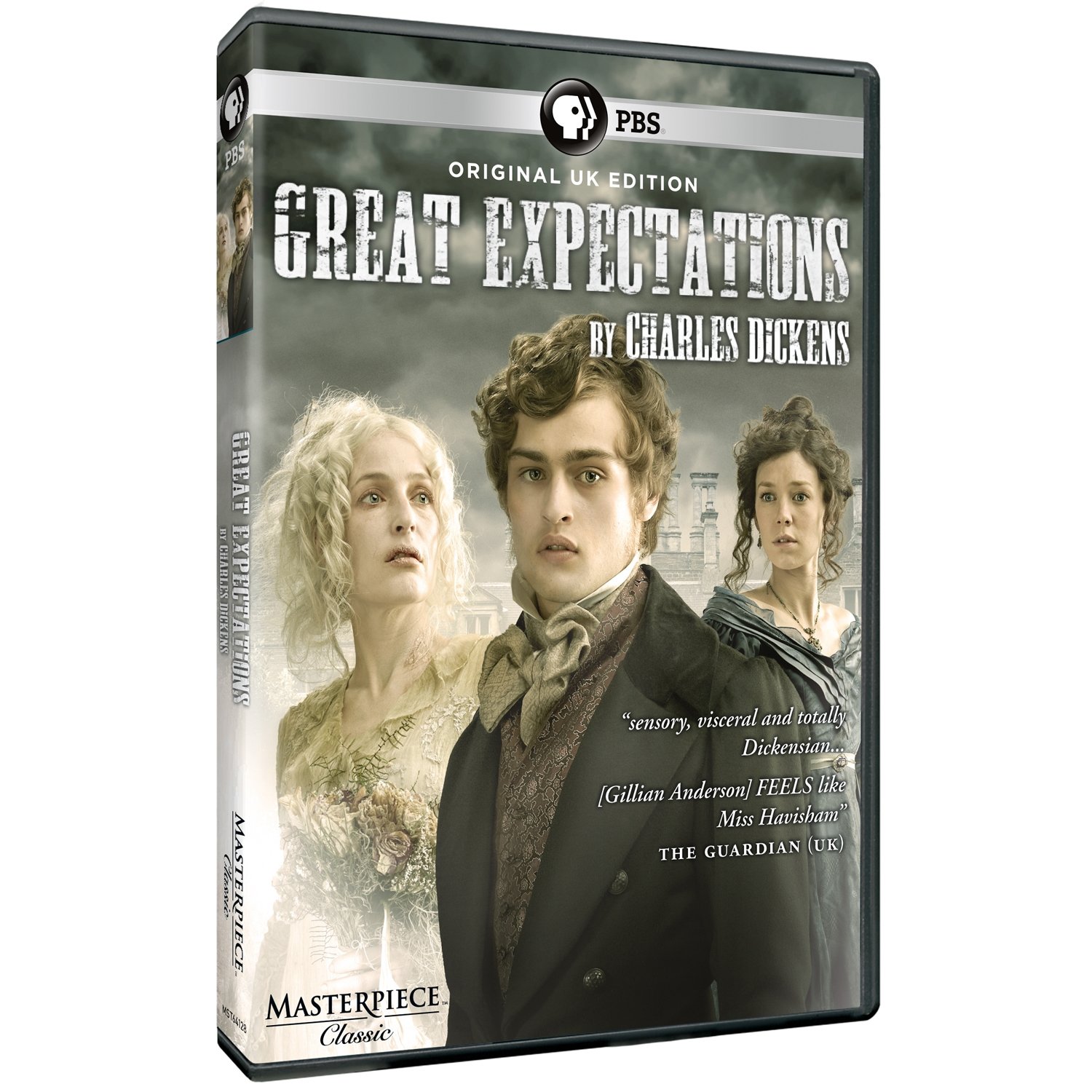
DVD Box Art
Synopsis
Young Pip is invited to the home of Miss Havisham to entertain her and Estella, a orphan that she raised after her fiancee abandoned her on her wedding day. Years later, Pip comes into a great fortune from an unknown benefactor that quickly changes his life. (Synopsis taken from my review of Great Expectations (1999))

Characters
There are some familiar faces in this miniseries that you may have seen in other period dramas. Miss Havisham is played by Gillian Anderson, who is also seen in Bleak House. Herbert Pocket is played by Harry Lloyd, who can been seen in Robin Hood and the recent version of Jane Eyre (and also the recent movie The Iron Lady). Herbert's fiancee, Clara, is played by Perdita Weeks, who was Lydia Bennet in Lost in Austen. And Jaggers is played by David Suchet, who was Melmotte in The Way We Live Now. Other than those faces, the rest of the cast was pretty new to me.

Miss Havisham is portrayed differently in this version of Great Expectations than the other version that I've seen. In the 1999 version, she was portrayed as being fully spiteful and always seeking revenge. In this one, she is still spiteful, but she is also a little insecure. There is a more sympathetic view taken of Miss Havisham in this miniseries. Spoiler Towards the end of the miniseries, Miss Havisham tells Pip that she wanted to hurt him and everyone else and that she was sorry for it and asks for Pip's forgiveness, which Pip grants. Also, the way Miss Havisham died in this miniseries was also different from the 1999 version (and from what I've read/heard, the book also). From what I've seen/heard/read about, in the book Miss Havisham was having an argument with Pip when she stood too close to the fire and caught on fire; even though Pip manages to put out the fire, she still dies from the burns. In this version, her and Pip have a talk (where she asks for his forgiveness) and Pip leaves; Miss Havisham proceeded to take what looked like love letters and her old bouquet, put on her wedding veil and proceeded down the stairs to the fireplace where she individually burns the letters and bouquet and drops them into the fireplace. One of those items happened to land too closely to her and lit her on fire. Pip, walking away outside, turns around to see that something has caught on fire at Satis House and runs back to help where, it is implied, is too late. Not sure how I feel about this interpretation other than I know it is different from the book. To me, it seemed like the film makers got a little artsy with this scene where they could have left the scene alone and do it like it was in the book.  End of Spoiler Between this Miss Havisham and the 90s one, I think I like this one a little bit more maybe because I got to see more of her and understand her better.

Various Characters from Great Expectations. From Left to
Right: Abel Magwitch, Estella Havisham, Miss Havisham,
Pip, and Jaggers.
Along with Miss Havisham, Estella is portrayed softer in this version. Miss Havisham does bring her up to not love, but I think that the way Estella is portrayed, she really does have feelings for Pip in spite of Miss Havisham's harsh upbringing. Estella warns Pip not to return to Satis House because of all the suffering there. Even when she says that she only used Pip, you could tell in her face that she didn't want to and that she felt bad about it. Spoiler Even on the way to her wedding to Drummle, she wants to stop the wedding (probably knowing that she has feelings for Pip and that Drummle would make her very unhappy), but she was forced to go through with it. End of Spoiler So, this Estella was more sympathetic than the other version. This Estella is portrayed as being powerless to everything going on around her. If Estella can be likable, this one was probably the most likable than the other Estella I've seen.

Of all the characters in this Great Expectations, the best character has to be Herbert Pocket. He was probably the most stable out of all the characters: no hidden back story, he cares for other characters, and he has no visible vices. Sure he got into a little fight with Pip when they were younger, but he grew out of it! He was probably my favorite character in the entire miniseries.

Pip... Not sure what to make of this Pip. I don't particularly care for the way that they made him look (more on that later). The acting was okay, I guess, but it didn't really stand out for me. Comparing this Pip to Ioan Gruffudd's Pip, I would say that they just about tie. Looking back on Ioan Gruffudd's Pip and this Pip, neither of them really made much of an impression on me. I will say that I liked younger Pip better than older Pip. I felt so bad for young Pip: everyone always mistreated him except for Joe Gargery, his sister's husband.

Scenery
Great Expectations is a bleak story, so don't expect the scenery to be very cheery. Many of the scenes were filmed in a greyish overtone, which reflected the tone of the story. The problem with that was that many characters looked extremely pale, like ghosts, in some scenes. I could understand Miss Havisham looking very pale, but not Pip or the other characters (well, maybe Estella, but probably not). My personal opinion is that I didn't care for the grey scenery, but it does fit in with the story.

Dining Hall of Satis House

Satis House was extremely dirty and the film makers made of point of it. There was a lot of mold growing in the house and even puddles? Now, I haven't read Great Expectations, so this could be a accurate portrayal of the house, but it seems to me like there isn't anyone that could live in that house without getting sick. How did Miss Havisham raise Estella there without either of them becoming gravely ill? I am glad that in this adaptation they left out the rats crawling all over the tables like the 1999 version. *Shutters*


Costumes
The costumes were okay. The fashionable ladies wore what looked like 1830s fashions towards the end of the miniseries, which leads me to think that the story took place over about 20 years (starting at 1812 and ending sometime in the 1830s).

Miss Havisham in her wedding dress.
Miss Havisham wore the same wedding dress that she had on for years (which is fitting). From the look of her wedding dress, it looks like she was supposed to be married sometime in the early Regency era. But this puts into question what her age really is. If the story starts in 1812 and we assume that Pip and Estella are about 7 and since Miss Havisham adopted Estella shortly after she was abandoned at the alter, I would say that Miss Havisham should have gotten married about 1805, so that would fall in the right era. Now, as for calculating Miss Havisham's age, that might be a little more difficult. If we assume she got married at 20, and we assume that Pip grows up to be about 27 or 28 before getting his inheritance, that would make Miss Havisham 45 by the end of the story (and 27 when the story begins): 27 is extremely young to have white hair, and at 45, she would still be too young to have completely white hair (unless it turned white prematurely when she was in her 20s). If she was an older bride, maybe 28?, that would make her 53 at the end, which is still young to have completely white hair. I guess I'm wondering about how they presented Miss Havisham's age. From the look of her face, she looks fairly young, but haggard, but the white hair makes her look older.

...Anyways! Onto another subject!

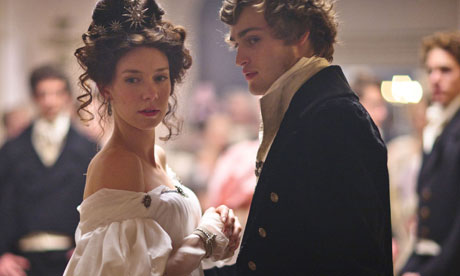
Estella and Pip after dancing.
I'm sorry, but I have issues with the way Pip and Estella looked. To me, Pip looked too girly and Estella wasn't girly enough. Estella didn't look terrible, but compared to Pip, Pip was the one that looked more girly. I don't know if it was something they did in makeup, but still that vexed me.

Estellas gowns were nice and pretty to look at. I do question some of their accuracy, however. Many of her dresses showed off her entire shoulder. For the 1830s, part of the shoulder was starting to be shown off, but I don't think it was as much as Estella was showing.

Overall: 2.5/5
Well, I know I rated this higher than the 90s version, but I'm still not quite sure which one I liked better. With this one, I felt like I knew the story better, but the other one was a little lighter (did I just say that?). Throughout most of the miniseries, I didn't particularly care for it, but I will say that it did get better towards the end. Content-wise, there is some violence and blood and some suggestive themes. If it was in theaters, it may earn a PG-13 Rating.

Great Expectations is available on DVD and Blu-Ray. It is made up of three one hour long episodes.

Friday, December 2, 2011

Two New Great Expectations... Two New Miss Havishams

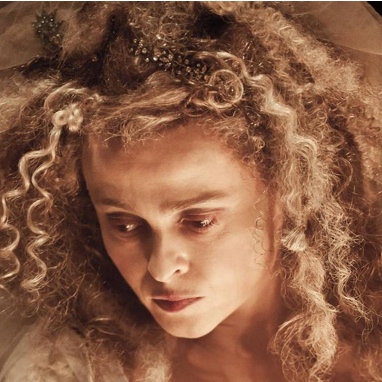
 You may have heard that there are going to be not just one, but two new adaptations of Great Expectations. And you may have also heard that two period drama actresses, Helena Bonham Carter (The King's Speech) and Gillian Anderson (Bleak House), are both to play Miss Havisham. But have you seen the pictures of their Miss Havisham's yet?

Helena Bonham Carter


Gillian Anderson


I noticed that Helena Bonham Carter's Miss Havisham is wearing Georgian Fashions (notice the heavily trimmed sleeves), while Gillian Anderson's is wearing Regency fashions. If the story starts around 1812, Helena Bonham Carter's Miss Havisham will have fashions that are at least fifteen years old and Gillian Anderson's would have more current fashions for the time. Would Gillian Anderson's Miss Havisham be portrayed as being much younger than how some of us might picture Miss Havisham? Of course, I've never read Great Expectations, so I can't really say which is more accurate to the story.

I also heard that one of the versions will have a different ending than the book...

What do you think? Who do you think will be the better Miss Havisham?

God Bless,
 God Bless, Miss Elizabeth Bennet

Tuesday, September 20, 2011

Oh no! The Period Drama I'm Watching Has Inaccurate Costuming!

If you're like me, one of the first things I notice in a period drama is the costuming. I love looking at the costumes and, since I like studying historical fashion, I try to pick out the era in which the story is taking place just by looking at the clothing.

But then it happens: you're watching a period drama and the clothing does not match up to the time period! Oh no!

Don't worry just yet -- there may be a chance that the period drama that you are viewing might not be as inaccurate as it seems. There are a couple of ways that characters can get away with using older fashions than the period the film is taking place. Note: These are just my observations and assumptions. I may have also read a little about this topic and can't place the exact source.

1. The character is an older/elderly character
The younger characters will want the latest fashions: they've never seen anything like it before -- they love the latest fashions -- they need them! However, if a character is older, chances are they like the fashions that they have and will therefore wear them instead of the current fashions.

Example

Mrs. Jennings (Sense and Sensibility) 
Time Period of Story: 1795 - 1820
Time Period of Fashion: 1780-1790s
I hesitated putting up Mrs. Jennings since she is a rich character (see #2), and does go out into society (see #4), which would make it seem like she would have the latest fashions, but you could make an argument that her dresses/hairstyle may be accurate. It's possible that she liked the Georgian Fashions of her youth better than the Regency Fashions and decided to stick to the Georgian Fashions. Although, they do make an attempt to give her a Regency waistline on her dress, the lace along the neckline looks Georgian, but her hair is definitely Georgian.

2. The character is poor
Obviously, if a character does not have a lot of money, money will mostly go to the absolute necessities and not on the latest fashions. Chances are, they clothes that the poorer characters would wear would most likely be hand-me-downs.

Example
Fanny Dorrit (Little Dorrit - 2008)
Time Period of Story: 1826
Time Period of Fashion: 1805 - 1820
Here, I'm mostly talking about Fanny during the first half of Little Dorrit. Fanny would possibly have gotten some hand-me-downs from the Regency Era that was once her mother's, and since the Dorrits were poor, she probably could not get newer clothes on her own. Little Dorrit takes place in about 1826; the Regency Era ended in 1820: from 1820 to 1830 the waistlines of the dresses began to descend until they hit the natural waist where they would remain for quite some time.

3. The character does not go out into society
There are a couple of characters in period dramas that never leave their house. Since they don't leave their homes, they don't need to get the latest fashions since no one (or few) will see them. They also may not be physically able to go to a store to look at the latest fashions and buy them.

Examples
Mrs. Clennam (Little Dorrit - 2008) 
Time Period of Story: 1826
Time Period of Fashion: 1795 - 1820

&

Miss Havisham (Great Expectations - 1999)
Time Period of Story: 1850s?
Time Period of Fashion: 1795 - 1820, possibly 1805 - 1820

Both characters are confined to the house they live in, but for different reasons. Mrs. Clennam cannot leave her house because she is an invalid and bound to a wheelchair. Miss Havisham's reason is that she had her heart broken on her wedding day and imposes solitude on herself. While Mrs. Clennam's confinement is physical and Miss Havisham's is emotional, either way both do not get out into society and therefore both do not really need newer clothes. You could also say that they're both older characters which could also be why they have older clothes (see #2).

4. The character does not live in/near town
If you're nearest to the big cities, you usually get your hands on the latest fashions right away. But out in the country and in a time when communication was much slower than it is today, it may take a little while for the latest fashions to appear. Unfortunately, I can't come up with a really good example of this, but it was something that occurred to me as a possibility of a character not having period clothing.


Hopefully, this will clear up some costuming issues you might have. Again, this is based on my observations and a little bit of what I've read. If you have any comments or corrections to this, please leave them.

 God Bless,
 God Bless, Miss Elizabeth Bennet

Monday, July 11, 2011

Review: Great Expectations

Box Art
I've never read Great Expectations, but I was aware of it and knew it was a classic. I noticed this film in a store once, but I kind of glanced past it. After a while, I noticed this movie on Youtube, so I thought I would give it a try on Youtube and see if I liked it or not.

Synopsis
Young Pip is invited to the home of Miss Havisham to entertain her and Estella, a orphan that she raised after her fiancee abandoned her on her wedding day. Years later, Pip comes into a great fortune from an unknown benefactor that quickly changes his life.

Characters
I only recognized three members of the cast. Though I haven't yet seen Amazing Grace (but I really want to!), I knew of Ioan Gruffudd (though I never realized it, he was also in 102 Dalmations, which I loved to watch as a kid) and he was Pip in this version of Great Expectations. Justine Waddell from Wives and Daughters was also in this adaptation as Estella. The last actor that I recognized: I saw Jaggers come onto the screen and I thought "Where have I seen him before", and it dawned on me that he was in Star Wars Episode I: The Phantom Menace (though not my favorite Star Wars movie). Other than those three, I didn't recognize anyone else in this Great Expectations.

Miss Havisham (seated) with young Estella
and young Pip
The acting overall was good. However, this was one of those movies where you like a couple of character, and the rest you either don't like too much or they just irritate you. Characters like Joe and Herbert I found to be likable, and, at first, I found Pip likable. Pip kind of got on my nerves after he got money: I thought he started to spend money irresponsibly, but this was probably the angle that Dickens was going for to prove a point; maybe Pip was similar to Mr. Dorrit in Little Dorrit -- how Mr. Dorrit got his money and started to act like a jerk to everyone from his past, only in Little Dorrit, there wasn't much of a sign that he was running out of money while he was spending it while in Great Expectations there is talk of Pip running out of money. But back to my original point, before Pip became rich, he seemed a lot more likable. Other characters, like Miss Havisham, Estella, and Mrs. Joe, I couldn't like too much. Well, maybe I felt more sorry for Estella after she got married, but before that I really didn't like her. Miss Havisham seemed to be a little "off her rocker" (for lack of a better phrase), and Mrs. Joe seemed to treat young Pip unfairly all the time.

Scenery
Since the story isn't really a happy story, you won't find much bright, colorful scenery as you would in other period dramas. Most scenes have a grayish tinge to them and, for the second half of the movie, take place in the middle of London. There are some scenes in the country, but they aren't anything spectacular.

Costumes
Justine Waddell as Estella
The costumes were good! Estella's dresses were very lovely to look at; they seemed to dress her in a lot of red (at least to my memory). Miss Havisham had only one dress: a Regency era wedding dress. It would make sense for her to have Regency fashion: yes, she is wealthy, but she also hasn't left her home in a very long time and she is also older.

Music
There wasn't much music to speak of. If there was a soundtrack to this miniseries, it would be composed of probably only one song: a very eerie song that seemed to pop up every once in a while. 

Overall: 2/5
I found this Great Expectations to be only tolerable. Some of the costumes were okay to look at, but not much else recommended itself to me. While the acting was good, I found a lot of the characters to be dislikable or irritating. I'm not quite sure if this version is accurate to the original story (though, from what I read on a synopsis, the ending was different), so if anyone out there has read the novel and can compare it with this adaptation, I would be thankful. Honestly, I probably wouldn't watch this version again, but maybe if a new version of Great Expectations came out (which, from what I hear, there are two in the making), I might watch it.

Great Expectations is available on DVD. It is a two part movie that runs all together for 168 minutes.